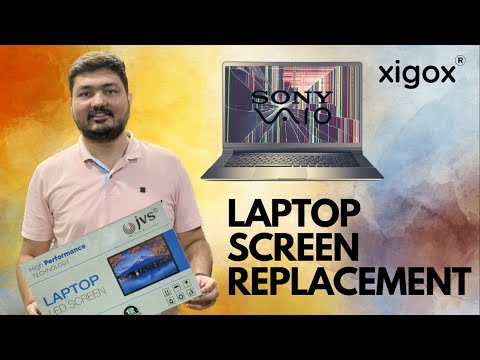
Replacing a laptop screen means swapping the display panel for one with the same size, resolution and connector, and the cost depends mostly on that panel. On our price list, indicative screen replacement for mainstream and gaming Windows laptops runs from ₹1,999 to ₹6,999, while MacBook displays run from ₹8,999 to ₹28,999. The job itself is usually quick once the correct panel is in hand.
How do you confirm the screen is the real problem?
Connect the laptop to an external monitor or TV over HDMI before you spend anything. If the external picture is perfect, the graphics hardware is healthy and the fault sits in the panel, its cable or its backlight. If the external picture is also broken, a replacement panel won't help.
These quick checks narrow it down further:
- Shine a torch at the dark screen. If you can faintly see the desktop, the panel is working and the backlight or its power circuit has failed. That's a different repair and often cheaper than a new panel.
- Move the lid slowly. Flicker, colour shifts or lines that change as the lid angle changes point to a worn or pinched display cable near the hinge, not a dead panel.
- Look at the pattern. Dark ink-like blotches or a spreading black patch after a knock mean the liquid-crystal layer is damaged. Fixed vertical lines or a band of colour usually mean the panel's driver electronics have failed. Both need a new panel.
- Check for a visible crack. A crack in the glass of a touchscreen can leave the picture working for a while, but it tends to spread and can cut your fingers.
If your symptom is flicker with no damage, read our flickering screen guide first. Many flicker cases turn out to be drivers or a cable.
What decides the price of a replacement panel?
Panel specification decides the price more than the laptop's brand. A basic 15.6-inch HD panel sits at the low end, and a high-refresh gaming panel, a touchscreen or an OLED sits much higher. Labour is similar across most models, so the quote moves with the part and with how hard the lid is to open.
| Factor | How it affects cost |
|---|---|
| Screen size | Larger panels cost more, and 17-inch parts are rarer than 14 and 15.6-inch ones |
| Resolution | HD costs less than Full HD, and QHD or 4K costs more again |
| Refresh rate | Gaming panels at 120 Hz or higher cost more than standard 60 Hz panels |
| Panel type | IPS is the common mid-range choice, OLED is the premium one |
| Touch | A touchscreen has an extra digitizer layer and costs more than the non-touch equivalent |
| Panel only or full lid | Some thin laptops sell the panel with the lid assembly, which raises the part cost |
| Collateral damage | A cracked bezel, bent hinge or damaged cable adds to the job |
Our IPS and OLED explainer shows why an OLED upgrade rarely makes sense as a cheap fix. The final figure always depends on the model and the exact panel, which is why we give a written quote after inspection. The inspection fee is ₹350 and is refunded if you go ahead with the repair.
Which panel specifications have to match?
The new panel must match the old one in physical size, resolution, connector type and pin count, refresh rate, and touch or non-touch. A panel that fits in the lid can still stay dark if the connector or signal type is different. That's why the laptop's model number alone isn't enough to order a part.
Most panels carry a printed label on the back with a part number. Typical examples look like NV156FHM from BOE, B156HAN from AUO and LP156WFC from LG Display. The "156" in each usually means 15.6 inches, which is a quick sanity check. Because the label is only visible once the bezel is off, a careful technician identifies the likely panel from the model first and confirms it when the lid is open.
Watch for these common traps:
- 30-pin versus 40-pin eDP connectors. Both are common on modern laptops, and 40-pin tends to appear on higher-refresh panels. They aren't interchangeable.
- Touch versus non-touch. You generally can't fit a touch panel to a laptop that never had the touch controller wired in.
- Matte versus glossy. Some models offer both finishes. We match what was fitted, since the cable and brackets differ.
- Bracket style. Some panels have metal side brackets, some have screw tabs, and some are held by adhesive strips.
How is a laptop screen replaced step by step?
A screen swap takes a few careful stages: power down, release the bezel, unscrew the panel, swap the cable, test, and close up. The skill lies in the bezel and the cable, not in the panel. Most accidental damage happens at those two points, which is why we don't suggest it as a first DIY project.
- Power down and disconnect. The laptop is shut down fully, the charger removed and, where the design allows, the internal battery connector is unplugged.
- Release the bezel. Rubber screw covers or stickers are lifted and the screws removed. The plastic bezel is then released with plastic tools along its clips, never with metal, which scars the lid.
- Remove the panel screws. The panel is tilted forward onto the keyboard area, supported so the cable isn't strained.
- Disconnect the cable. A strip of tape usually covers the connector. It's peeled back, the latch is released and the cable slid out.
- Fit the new panel. The cable goes into the new panel and is locked and re-taped, and the panel is set into the lid.
- Test before closing up. Brightness, colour, dead pixels, touch response and the webcam are checked while the bezel is still off.
- Reassemble. The bezel is clipped on, screws are replaced and the antenna wires are checked to make sure none is pinched along the hinge.
That last point matters. Wi-Fi antenna cables often run beside the display cable through the hinge, and a pinched wire can leave you with a perfect new screen and a laptop that won't hold a Wi-Fi signal. Testing the connection before returning the laptop catches it.
Is replacing the screen worth it, or are there alternatives?
Replacement is worth it when the laptop is otherwise healthy and the quote is well below the cost of an equivalent refurbished machine. If the laptop is old, slow and has other faults, the screen may be the final straw. A useful comparison is the quote against what a similar refurbished model would cost.
When an external monitor is enough
If the laptop sits on a desk, an external monitor plus keyboard turns a broken-screen laptop into a perfectly usable desktop for very little. It's also a safe way to copy your files before any repair. It doesn't suit anyone who travels with the machine.
When to repair rather than replace
A loose cable, a dead backlight circuit or a bent hinge is cheaper to fix than a new panel. Our guide to cracked laptop screens sets out which damage can be repaired and which can't. If the lid itself is cracked or the hinges are loose, plan for those repairs alongside the panel.
MacBooks and all-in-one PCs
MacBook displays are sold as complete lid assemblies, so the range is wider and starts higher. See our MacBook screen repair page for model details. Large all-in-one panels, such as 27-inch 4K or 5K ones, are also priced differently from laptop panels.
Frequently asked questions
Will I lose my data when the screen is replaced?
No. A screen replacement doesn't touch the storage drive. We still recommend a backup before any repair, because a drop that cracked the screen could also have affected the drive.
Can any panel of the same size be fitted?
No. Size is only one of several things that must match. Connector, pin count, resolution, refresh rate and touch support all matter, and a mismatch means a blank or distorted display.
How long does a screen replacement take?
Many common repairs finish the same day, but a panel is specific to the model. We confirm stock and timing in the written quote rather than promising a figure before we know which panel you need.
Is a few dead pixels a reason to replace the screen?
Not usually. A single stuck or dead pixel is cosmetic and often tolerable. A growing cluster, a spreading patch or lines across the picture do justify a replacement.
To see what your own model would cost, book a free pickup or send us the model number, and compare it with our published price list. Xigox also gives a 90-day warranty on the replacement. For the standard service details, visit our laptop screen replacement page.